
A Short, Unfair History of Asian Parents on Screen
From Fu Manchu to tiger moms: how film and TV shaped the story of Asian parenting, and why that matters when you are planning a family.
Hollywood spent a century teaching the world what Asian parents are supposed to look like. Most of it was wrong.
If you are thinking about kids, you have probably already met Asian parents on screen. Maybe as a joke. Maybe as a warning. Maybe as the reason a relative says, "We are not like that." The problem is not that fiction exists. Every culture gets exaggerated on television. The problem is how thin the archive has been. For decades, American and Canadian audiences rarely saw Asian mothers and fathers as full people: tired after work, proud at graduation, awkward during sex talks, relieved when the baby finally sleeps. Instead they got types. The dragon mother. The silent father. The genius child with no visible parents at all.
A USC Annenberg Inclusion Initiative study of 1,300 top-grossing U.S. films from 2007 to 2019 found that 5.9% of speaking characters were Asian or Pacific Islander, below the then-7.1% U.S. population share. Nearly two-thirds of those films fell below proportional API representation, and 39% included no API characters at all. A separate Geena Davis Institute analysis of domestic top-grossing films from 2010 to 2019 found API actors in just 4.5% of lead or co-lead roles. Media does not assign your values, but it fills the silence when real guidance is missing. Asian parents do not get fair treatment as normal parents who want good lives for their children, the way other parents do. That leaves little guidance and little pride for the moment you are ready to begin.
The early century: villains, servants, and no family dinner scenes
For much of Hollywood's first hundred years, Chinese and broader Asian characters were rarely neighbors or PTA members. They were threats, servants, or background color. Film scholars routinely point to figures like Fu Manchu, the Dragon Lady, Charlie Chan, and the passive "China Doll" as recurring templates that denied Asian characters interior lives or ordinary families. The Dragon Lady and Lotus Blossom taught audiences to read Asian mothers as mood, not motive. Fu Manchu and his lineage framed Asian fathers as cold or foreign. Charlie Chan turned elders into props. The model minority math genius let kids carry pressure while parents vanished from the frame. The perpetual foreigner accent made belonging always conditional.
Wayne Wang's Chan Is Missing (1982) and Dim Sum: A Little Bit of Heart (1985) are often cited as early breaks from that pattern. Dim Sum offered something radical for its time: a widowed mother and her adult daughter in San Francisco Chinatown, arguing about love and duty without a white translator character. Still, those films were exceptions in an industry built on yellowface. The Good Earth (1937) famously put white actors in lead Chinese roles. Generations of viewers learned to see Asian people on screen only when the plot needed an exotic accent or a moral lesson about the West.
When Asian families finally appeared, they arrived under pressure
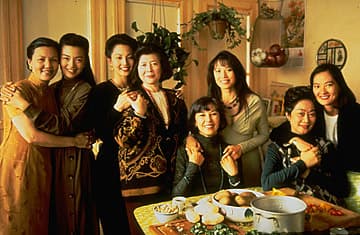
The Joy Luck Club (1993), adapted from Amy Tan's novel, was a landmark: four Chinese immigrant mothers and their American daughters, with grief, ambition, and rivalry on the table. It also fixed a template that would stick for years. Immigrant mothers as demanding. Daughters as torn. Love expressed through criticism.
A year later, ABC put Margaret Cho at the center of All-American Girl, the first major network sitcom focused on a Korean American family in the 1990s. Cho played Margaret Kim, a twenty-something clashing with traditional parents. Historians of television treat the show as groundbreaking and bruising. Cho later described network pressure to change her body and soften her comedy. Ratings struggled. ABC reworked the show toward a Friends-style ensemble with more white roommates. It was canceled after one season in 1995.
Cho has said that for many Korean Americans in the 1990s, the last vivid image of Koreans on national television was not a family at dinner. It was news footage from the 1992 Los Angeles uprising showing business owners on rooftops. When your community enters the story through crisis, you understand why parents get controlling about image. After All-American Girl, U.S. broadcast networks waited two decades before another Asian American family sitcom in the same lane. Fresh Off the Boat premiered on ABC in 2015 and ran five seasons. In between, Asian parents mostly lived in guest roles, punch lines, or memory montages.
The tiger mom decade
In January 2011, Yale law professor Amy Chua published Battle Hymn of the Tiger Mother. A Wall Street Journal excerpt titled "Why Chinese Mothers Are Superior" turned a memoir about one household into a national referendum on Asian parenting. Chua described strict rules around grades, music practice, and sleepovers. The piece provoked outrage, envy, parody, and talk-show segments.
Researchers at NYU and elsewhere have noted the irony: Chua's own daughters publicly described happy outcomes, while much of the public conversation treated "tiger mother" as the default Chinese American parent. Committee of 100's media glossary points out that the trope can flip quickly from affectionate family joke to cultural threat, echoing older "yellow peril" fears about Asian competition. Television leaned in. Gilmore Girls had Mrs. Kim. Later films and shows stacked stern immigrant mothers without backstory. Critics argued that the tiger mom became a convenient way to mark Asian mothers as foreign while congratulating white audiences for being more balanced. Real Asian parents were running restaurants, night shifts, ESL classes, and church potlucks. Screen parents were drilling scales.
Canada's parallel gap
The U.S. does not own this problem. A 2005 CRTC task force report noted that Canadians of Asian and Southeast Asian descent were already the country's largest visible minority group at roughly 1.7 million people in the 2001 Census, yet were significantly less likely to be represented onscreen across genres. In 2022, the Vancouver Asian Film Festival's audit of one week of programming on CBC, CTV, Global, Citytv, and B.C.'s Knowledge Network found Asian representation in main cast roles averaging about 8% across national broadcasters, with Knowledge Network at 3.9%. More than half of scripted content in the sample came from outside Canada.
Kim's Convenience, which ran on CBC from 2016 to 2021, became the rare national hit centered on a Korean Canadian family running a Toronto corner store. One good sitcom cannot carry a country, but it proved the appetite was there all along.
The better recent chapter
Minari (2020), Lee Isaac Chung's semi-autobiographical film about a Korean American family farming in 1980s Arkansas, earned six Academy Award nominations and a supporting actress win for Yuh-Jung Youn. Alan Yang's Tigertail (2020) traced a Taiwanese immigrant father's regret across decades. Turning Red (2022) and Everything Everywhere All at Once (2022) both drew praise for letting immigrant mothers carry shame, humor, and tenderness in the same scene.
These films still arrive after long droughts, which means each one carries unfair weight. USC's qualitative review of 2019's top films found API men emasculated or partnerless in more than half of cases studied, and API women still funneled into stereotyped roles. Progress on screen has been real. Proportionate, steady, and diverse progress has not.
Real parents, real timing
U.S. vital statistics for 2023 show Asian mothers with the highest mean age at first birth among major racial groups, at 31.5 years, compared with 28.3 for white mothers and 25.9 for Black mothers. Births to Asian women declined 1% year over year, and the general fertility rate for Asian women fell 3%. Those numbers do not tell you how anyone should parent. They do complicate the screen story. The tiger mom era coincided with rising age at first birth, more dual-income households, and immigrant parents navigating school systems in a second language. Television rarely showed that spreadsheet anxiety. It showed a woman snatching a violin.
Korean, Chinese, Filipino, and South Asian parents do not share one culture of discipline. They share a media environment that has often treated them as interchangeable.
What to do with this when you are starting out
You cannot fix Hollywood from your living room. You can refuse to let outdated casting rooms become your family mission statement. Build a personal canon. Keep Minari, Kim's Convenience, The Farewell, or whatever film made you feel seen. If you have kids already, talk about stereotypes the way you talk about bad science in cop shows: name the trope, ask what is missing, change the channel when a show cannot be bothered.
If you are Asian and planning a family, give yourself permission to want normal things: sleep, fair schools, kind in-laws, a decent takeout night. The screen archive tried to convince you that your parenting would either be a punch line or a performance review. Real life is more boring and more beautiful than that.