
A National Book Award Winner for the AIDS History Talk at Home
David Levithan and Gabriel Duckels’s The Fight of Our Lives: AIDS in America took the 2026 Young People’s Literature prize. The hybrid YA nonfiction is for ages 14 and up. Here is the form, what it covers, and one question for after.
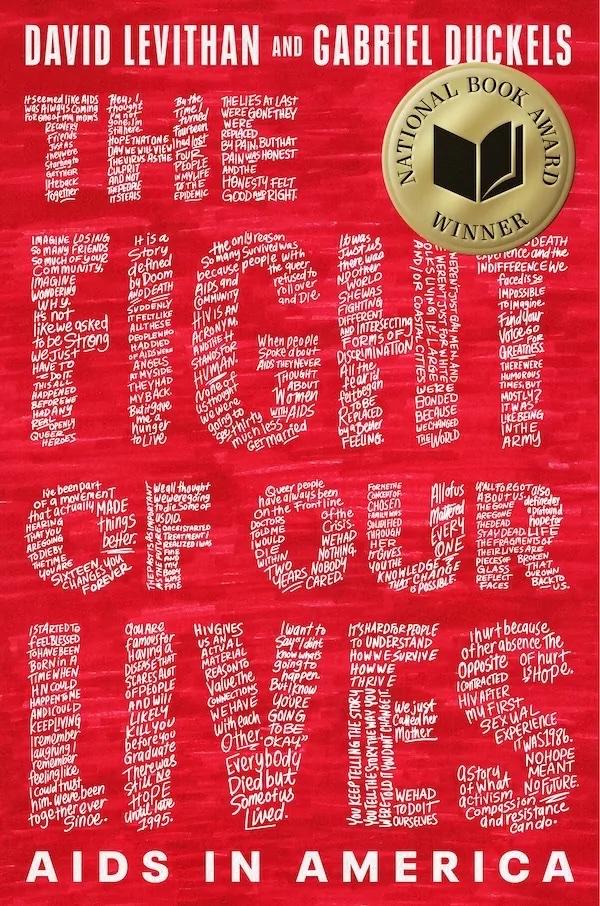
On Nov. 18 in New York, the National Book Award for Young People’s Literature went to The Fight of Our Lives: AIDS in America, by David Levithan and Gabriel Duckels.
Some headlines called it a graphic novel. It is not. Knopf’s 480-page YA nonfiction reads more like a living archive: timelines, essays, poems, interviews, old media, and a short wordless stretch illustrated by Brian Selznick.
Penguin Random House lists it for ages 14 and up. That fits most households.
Younger kids need a different door in. Older teens and adults can share the same pages.
The award is why the book is in your feed this week. The reason to bring it home is quieter: a lot of families still wait for a school unit on AIDS history that never quite arrives.
Many teens still get AIDS history as a rumor, a movie clip, or silence. This book gives a family something concrete to read together, with a clear age floor.
What you are holding
Think scrapbook and documentary more than chapter novel. Levithan and Duckels move through history in pieces that sometimes crash together on purpose.
Horn Book says that dissonance is intentional, a way to echo how the crisis felt while people were living through it. Some stretches run loosely by year. Others gather around a theme or a cultural artifact.
You will meet famous names and plenty of people who were never famous. Source pages reprint material from the 1980s and 1990s the way it first appeared.
Poems and personal essays sit beside the timeline. Selznick’s short wordless sequence is one quiet beat inside a much larger collage.
The bright red cover is a wall of quotations from people touched by the crisis. Duckels thanked those voices when he accepted the award. The book is crowded on purpose.
What history shows up
The through-line is the U.S. AIDS epidemic: early panic and neglect, grassroots care when institutions lagged, activism that forced attention, and the long road from a death sentence toward treatments that let many people live full lives.
Along the way the book touches Ryan White, ACT UP, Larry Kramer, Anthony Fauci, Pedro Zamora from MTV’s The Real World, and the NAMES Project AIDS Memorial Quilt. Treat those as doors, not the whole hallway.
It also keeps saying the story is unfinished. People still die of AIDS-related illness when they cannot get care. Duckels said from the stage that HIV and AIDS belong to the present, and that young people deserve the legacy without a simplified version.
Levithan used his remarks to speak to queer storytellers whose books keep getting challenged. Parents should hear that too. The history in these pages is still argued over in some school boards and living rooms.
Who should read it, and how
Start with the publisher’s floor: 14 and up. A mature 13-year-old who already asks hard questions might join with a parent beside them. Middle-grade kids need a shorter, gentler path first.
Plan for feeling. Starred reviews call the book accessible and rigorous. It is still heavy.
Grief, anger, love, and sass all show up. A chapter a night, then a short talk, often works better than a weekend binge.
If your teen is queer, or has queer friends, or has a relative who lived through the 1980s and 1990s, say that out loud before you open the book. "Some of this may feel close. We can pause."
Adults who skipped this history the first time can read it without pretending they already know. The interviews and source pages were built for that gap.
One question after you close it
Keep the post-read talk to one question so nobody turns the couch into a quiz.
Try this: "Which person’s story stayed with you, and what part of this history did you think was finished before you opened the book?"
Let the silence sit. If the answer is thin, offer yours first. Name one figure, one protest, or one quilt panel that surprised you.
Then leave room for another conversation next week. One shared page is enough for tonight.