
Teachers Get New Prompts for Family Stories Told in Many Languages
An NCTE session in Philadelphia on Sunday laid out classroom questions for communal storytelling. Presenters Crystal Hsia, Livia Blackburne, Joyce Chu, and Nancy Wei focused on what to do when a child’s account arrives half-translated or in more than one family version.
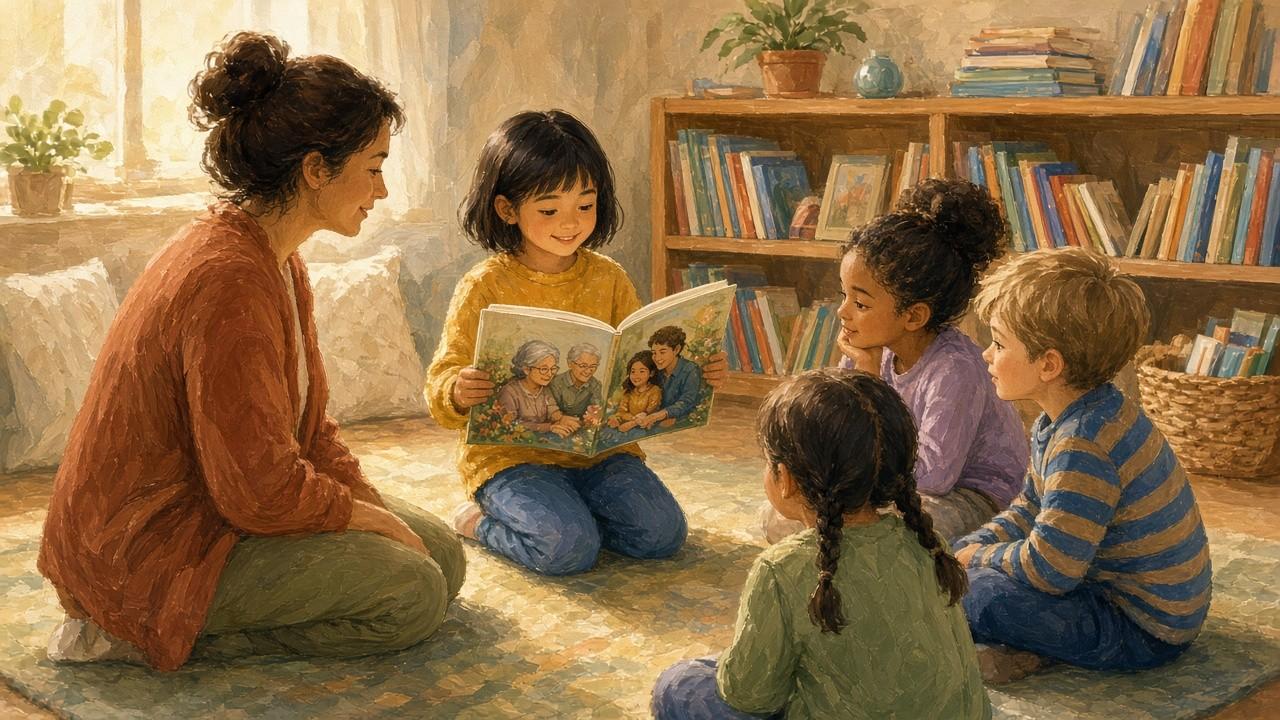
On Sunday morning in Philadelphia, English teachers filled a room for a session on family stories that arrive messy.
The panel was “Communal Storytelling in the Classroom: From Text to Shared Context,” 10:30 to 11:45 a.m. at the 2026 NCTE Annual Convention. Crystal Hsia of USC’s U.S.-China Institute presented with author Livia Blackburne and teachers Joyce Chu and Nancy Wei.
The USC U.S.-China Institute and the National Consortium for Teaching about Asia posted the session materials ahead of time. The books and prompts span many grade levels. The method starts with one student’s response, then asks the class to talk together about history, migration, memory, and identity.
Parents already live this at the dinner table.
Grandma may tell the story in Mandarin. Dad may leave out the hard parts. The child may blend both versions, then freeze when someone asks which one is true.
Family stories often arrive half-translated and half-revised. Teachers need questions that keep the child talking when there is no single official plot.
What the panel put on the table
Organizers describe communal storytelling as a way to move from solitary reading to shared understanding, while keeping what each student noticed first.
According to the institute page, Blackburne focuses on narrative perspective, historical framing, and thematic tension as openings for group interpretation. Chu and Wei bring classroom practice. Hsia connects the work to NCTA’s East Asia teaching network.
The demo books run from grandmother visits to public history: Bing’s Cherries, I Dream of Popo, Nainai’s Mountain, and Dreams to Ashes: The 1871 Los Angeles Chinatown Massacre.
Some children walk in with a video-call story about Popo. Others walk in with a massacre they have never heard named at home. The same lesson has to make room for both.
When the story arrives in another language
I Dream of Popo follows a child who moves from Taiwan to the United States and watches language shift among home, school, and dreams. Treat English-only retelling as the finish line, and half the story stays unsaid.
Ask questions that leave room for the first language. "Which words did you keep in the original?" "What did Popo call that dish?" "Can you teach us one line the way you heard it?"
At NCTE in 2025, Chu used food as an easy entry into identity and migration. The same move works with family stories. A dumpling or a cherry can carry a word the child is not ready to translate in full sentences.
Wei teaches Chinese at Palos Verdes High School. In a school profile, she said she wants students to become lifetime learners across subjects, not only language class.
That stance helps when a family story is bilingual and unfinished. Get the meaning first. The polished English speech can wait.
When there are several versions
Bing’s Cherries is made for this tangle. A girl and her father retell Ah Bing’s life as history, family memory, and tall tale while they eat cherries from the backyard.
Dreams to Ashes points the class toward a shared record of the 1871 Los Angeles Chinatown Massacre. Nainai’s Mountain layers a child’s first trip to Taiwan with a grandmother’s older stories about the same places.
Those books give teachers a way to handle disagreement at home.
Ask who told the child the story. Ask what changes when Dad tells it and when Grandma tells it.
Ask what the book presents as fact, what it marks as imagination, and what the class still needs to look up.
Blackburne’s spring USCI/NCTA educator seminar laid out the same sequence: personal experience, then community and cultural narrative, then myth and shared imagination. Knowing that sequence, she told teachers, helps students ask better cultural questions instead of hunting for one correct bedtime plot.
Prompts you can use Monday
Use the tools the organizers named: collaborative meaning-making, shared writing, guided reflection, and inquiry talk.
After a read-aloud, put a shared stem on the board: "In my family this story is told as…" Let kids finish in English, a heritage language, or both.
Pair students to compare versions. "What stayed the same? What changed? What do we still not know?" Do not pick a winner.
Send one question home that keeps the child safe: "Who else in our family remembers this, and how do they tell it?" Bring those notes back for a class chart of tellers, languages, and open questions.
Leave the chart unfinished. In the organizers’ terms, communal storytelling aims for shared context, not one cleaned-up answer.
One note for parents talking with a teacher
If your child’s school used one of these books this week, ask what the class did when versions conflicted.
Teachers usually want the family’s words. You can say: "There are two versions at our house. We can send both."
If you are the teacher, Hsia’s NCTA materials give cover to go slowly. East Asian and Asian American texts belong in ordinary literacy time: discussion, writing, and reflection that can hold more than one teller.