
After Kids, Are You Still a Couple?
After a first baby, happiness in the marriage drops suddenly, and it often stays. The hour worth putting back is the one with no task in it.
You can run the household and still notice, on a Thursday, that you have not been a couple since the baby started sleeping in the next room.
Anjali Mehta writes about marriage, in-laws, family planning, and the quiet negotiations of South Asian family life in North America.
The list is winning
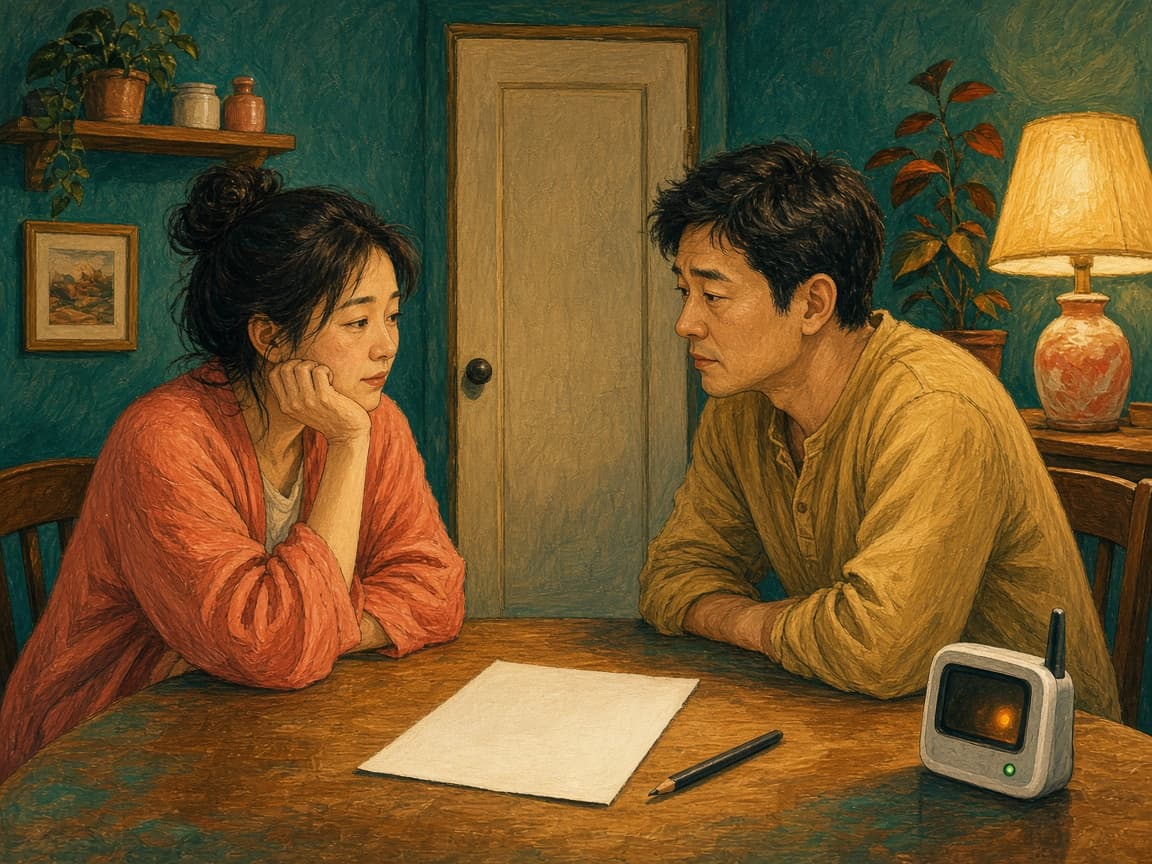
You know the pediatrician's after-hours line. You know which grandparent gets the Sunday call. You are not sure when you last sat down with nothing to solve.
One of you says, "We're fine," and means the bills are paid.
The break at the birth
Brian Doss, a couples researcher then at Texas A&M, followed 132 couples who had a first child during the first eight years of marriage. They had signed up through the religious groups that would perform the wedding. At the start they were about 26, and about nine in ten were white.
The happiness question runs from 1 (very unhappy) to 7 (perfectly happy). After the birth, mothers dropped about 2.8 points and fathers about 1.8.
Both were suddenly sharper when an observer scored a conversation about a problem.
Mothers also reported a sudden rise in how intense the problems felt, worse conflict habits, and less confidence that the two of them could handle the relationship. Fathers showed a sudden dip in dedication.
Another 86 couples in the same project had no child across those eight years. Their happiness slid too, gradually. They did not show the sudden break.
Doss's group reads the parents' break as tied to the birth.
Danielle Mitnick led a review of 37 studies that same year. It found small drops from pregnancy through about 11 months.
Four studies of newlyweds who did not have a baby found a slide of a similar size over a similar stretch. Year one can feel worse whether or not a baby arrived. The eight-year study is the one that can see the break at the birth itself.
The hour that leaves
Amy Claxton and Maureen Perry-Jenkins talked with 147 dual-earner, working-class, heterosexual couples who were having a first baby. Leisure fell after the birth, then started to climb once the mother went back to work.
Wives who had more shared leisure before the birth reported more love, and less conflict, a year later. Husbands who had more time to themselves before the birth reported less love and more conflict a year later.
The sample is working-class, and it is not described as Asian. What it shows is how fast the unscheduled hour goes, and which kind of hour was already predicting the year.
The phone at the table is a different fight: Your Partner Is on Their Phone Every Dinner While You Parent. This one is the hour with no task in it.
Put one hour on the week
Pick 45 minutes that are not a planning meeting. Leave the budget and the visit calendar for another night. A walk after the child is down works, or breakfast out if someone can take the morning, on the same day each week for a month.
Those 45 minutes are a suggestion. They are not a result from either study.
If the only free hour is one of you alone, and you have been calling it recovery, say that out loud. In the Claxton interviews, his time alone before the baby was already tied to less love and more conflict a year later. Recovery can be real. It can also be the couple's hour leaving by the side door.