
You Checked the Census Box for Your Kid. Would They Check the Same One at 18?
A Social Science Research study linked Census answers from 2000 to 2020 for 2,509 people with one Asian Indian parent. Multiracial showed up most often overall. Among those with one White parent, White was the most likely single box in childhood and in adulthood.
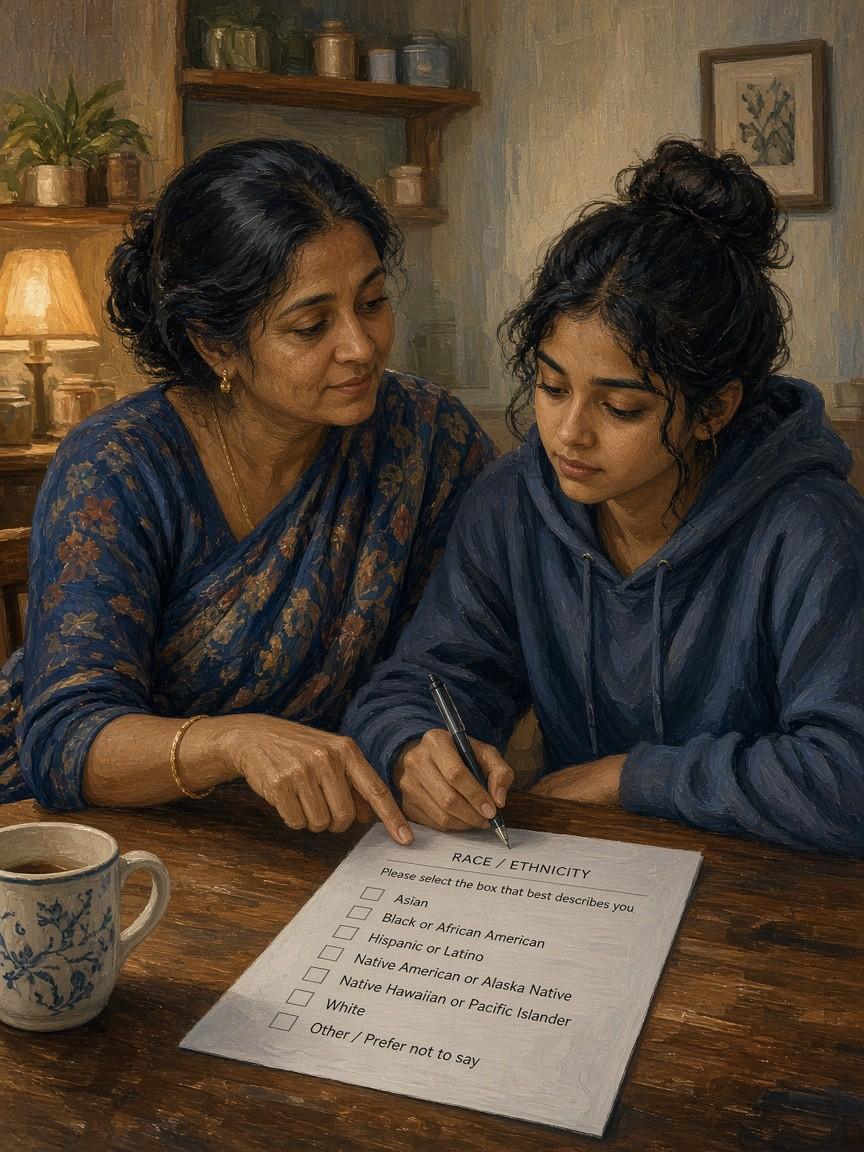
The form is on the kitchen table. Someone has to mark the race boxes.
For years that someone was you. You knew the family tree better than your child did, and the Census wanted an answer while they were still learning to spell their middle name.
Luna Chandna, a demographer at Portland State University, linked restricted Census records for 2,509 people who had only one Asian Indian parent. She followed those same people from the 2000 Census, when a parent often filled in the race boxes, into the 2020 Census, when they answered for themselves as adults.
The paper is in the November issue of Social Science Research. For parents, the live question is what happens the first time you slide the pen across the table and stay quiet.
A Census checkbox is a government category. What your kid says at school, with cousins, or on a dating profile can be longer and can change. Handing over the form is one early practice round for that difference.
What the linked Census answers show
Chandna's sample is tight on purpose: one Asian Indian parent, and one parent who is not. That second parent might be White, another Asian group, or another race. People with two Asian Indian parents are outside this paper.
Across the full sample, Multiracial was the most common identification. Plenty of families still treat "mixed" as a childhood phase that will settle into one box later. These records push against that habit.
Among people with one Asian Indian parent and one White parent, White was the most likely single category in childhood and again in adulthood. Chandna points out that the old one-drop rule, the idea that any non-White ancestry automatically sorts someone into a minority category, was not the main pattern here.
Having an Asian Indian mother or an Asian Indian father alone did not reliably predict an Asian Indian identification. Having only an Asian Indian mother lined up with a lower chance of self-identifying as Asian Indian as an adult. Higher income lined up with a Multiracial mark.
The study will not pick your teenager's boxes for you. What it shows is that the childhood mark and the adult mark are connected, and that connection still leaves room to shift.
The moment you hand over the form
Try the quiet version. Slide the paper across.
Say: "These boxes are how the government counts people. You can mark more than one. Take a minute. I will not correct the pen."
Then stop talking. You will want to narrate their face, their last name, or what the in-laws prefer. Resist that.
Watch which boxes they reach for when nobody is coaching.
If they ask what you put when they were little, answer straight. "I marked both," or "I marked Asian Indian," or "I marked White and Asian Indian." Skip the speech about matching you.
If the form only allows one bubble, practice a calm line together: "My family is more than one thing. I put the closest fit and I can explain."
School worksheets and medical portals are often stricter than the Census. The Census has allowed more than one race since 2000.
Census boxes and heritage talk do different jobs
A checkbox answers a counting question. Heritage talk answers a kitchen question: who are we, what do we cook, which languages show up on FaceTime, which holidays feel like home.
Your teenager can mark White on a form and still say Indian American at lunch. They can mark Multiracial and still lead with Gujarati, Malayali, or "Dad's side is from Kerala" when a classmate asks. Both can be true in the same week.
Say the difference out loud. "On the Census, you choose among the categories they offer. When someone asks about our family, use the words that fit the conversation."
Kids need that permission so a government form does not turn into a loyalty test. Grandparents need it so a checkbox does not sound like a rejection of the whole lineage.
If relatives push, try a short bridge: "The form is for counting. At home we still say Punjabi and Irish, or Indian and White, or whatever our house actually is."
What to do with the study at your table
Treat Chandna's findings as a pattern map. They are not a forecast for your child. Her sample is people with one Asian Indian parent in linked Census files.
Your household may be Chinese and Mexican, Korean and Black, Filipino and White, or two Asian groups. The same idea still helps: the childhood mark, the adult mark, and the spoken identity can line up without being identical.
If your kid is still young, keep marking carefully and write down what you chose. When they are old enough to hold the pen, let them try once on a practice printout before a real deadline.
If they are already 16 or 17, ask what they would put on a form today, then ask what they would tell a new friend. Where those answers diverge, leave the gap alone for a beat. You do not have to solve it in one sitting.
Population models often assume Multiracial kids stay Multiracial. Chandna's work is one reminder that identification can move. At your table, the next step is smaller: make room for the pen to change hands.