
How to Explain the 442nd When Your Child Asks What Veterans Day Is For
Start with Densho's Minidoka photo of men lining up for Army physicals inside an incarceration camp. Then tell them about the 442nd: Japanese American soldiers who served while their communities were locked up.
At school, Veterans Day often arrives as a flag, a quiet minute, and a worksheet. At home, the question is sharper: What is the day for?
Pull up one Densho photograph before you answer. Object ddr-densho-37-1 shows a pre-induction physical at Minidoka, the Idaho incarceration camp. The old War Relocation Authority caption says Minidoka produced more Japanese American military volunteers than any other camp.
Those men were lining up for the Army inside a place the government had forced them into. Many would serve in the 442nd Regimental Combat Team, a segregated unit of Japanese American soldiers whose families, in a lot of cases, were still behind barbed wire.
The holiday gets specific when a child can look at camp clothes and Army gear in the same conversation.
Two pictures, same war
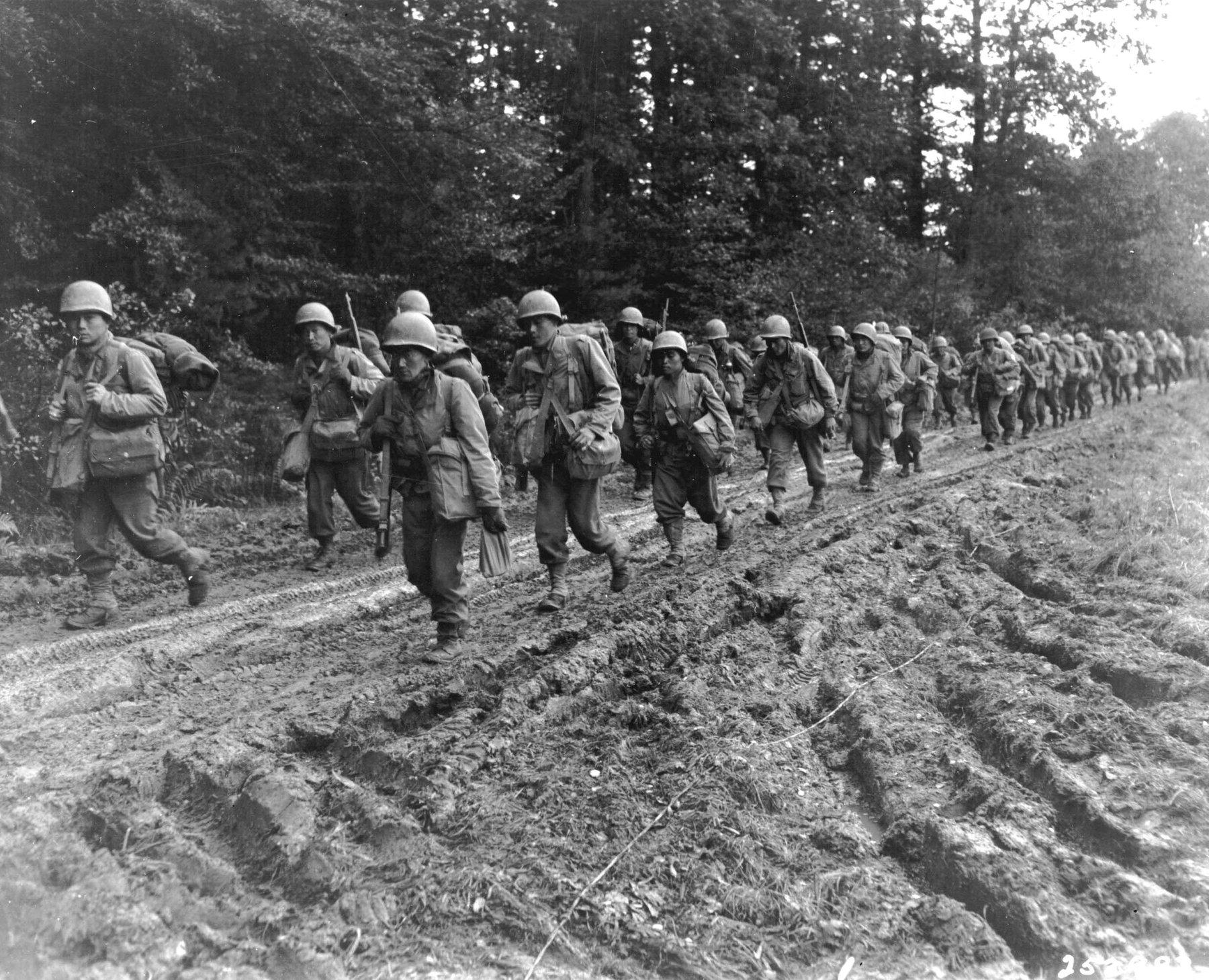
Keep the Densho image open. Men in camp clothes, waiting for Army exams. Then show the 442nd on a muddy road in France: helmets, packs, rifles.
Both belong to the same country and the same war. Some Japanese American men volunteered from Hawai'i, where there was no mass West Coast-style removal. Others volunteered, or were later drafted, from behind barbed wire.
Densho's encyclopedia says the War Department first hoped for roughly equal numbers from Hawai'i and the mainland. Hawai'i answered in a rush. The mainland, angry and confined, sent far fewer at first. The unit still formed.
Leave the battle maps for another night. The first job is the hard overlap: locked up at home, in uniform overseas.
If they are in elementary school
Stay with people and places you can point to on a screen.
You can say: "Veterans Day is for people who served in the American military. Some Japanese American soldiers served in a unit called the 442nd while their parents, brothers, sisters, or friends were forced to live in camps far from home."
If they ask why the camps existed, keep the answer short. After Pearl Harbor, the government treated Japanese Americans on the West Coast as a threat and removed about 120,000 people, including many American citizens. Congress later called the incarceration a grave injustice. Serving in the Army did not make the camps fair.
Then ask something small: "What do you notice in this Minidoka photo?"
Hold the medals for later. A younger kid needs the story to hang together before they need the decorations.
If they are in middle school
Older kids can take the draft label and the motto.
You can say: "For more than a year, many Japanese Americans were labeled 4-C, enemy aliens, and kept out of combat. Then the Army formed a segregated unit, the 442nd. Their motto was 'Go for Broke,' gambler slang from Hawai'i for risking everything on one big try."
Bring it closer to a kitchen table. Some men left camp for training at Camp Shelby, Mississippi, while grandparents stayed behind the wire. Letters went between France and a barrack address.
Ask: "If your country put your family in a camp, what would make serving feel necessary? What would make it feel impossible?"
Let them argue. The point is not a loyalty score. It is practice sitting with history that holds more than one true thing at once.
One question for an older relative
If someone in your family lived through those years, or grew up with a 442nd or Military Intelligence Service story nearby, keep dinner from turning into a quiz.
Give the child one question, with you in the room:
"Did anyone in our family serve in the war, or know someone who did, while people were in the camps? What do you want me to know about that?"
If the relative declines, thank them and stop. Densho's oral histories can carry the story when a living relative cannot.
No Japanese American elder at the table? Ask a teacher, a neighbor who served, or a museum docent. Kids remember people who answer more than they remember a handout.
What to do before the assembly
Before school, or in the car afterward, open the Densho Minidoka photo and read the caption together. Then look at the 442nd on the French road.
Say the age-fit lines in your own words. Stop while they still want to ask something.
If a relative might take a call this week, text the question ahead of time so nobody gets ambushed over rice.
Save the longer curriculum for another night. For November 11, one holiday, one archive photo, and one honest sentence about the camps will do.