
Kiki and the New Magic Arrives in English
Delacorte’s August 25 release is the first English edition of Eiko Kadono’s second Kiki novel. Kiki is fourteen, newly famous in Koriko, and starting to wonder what her work is for. Families who know only the Studio Ghibli film get a much quieter continuation.
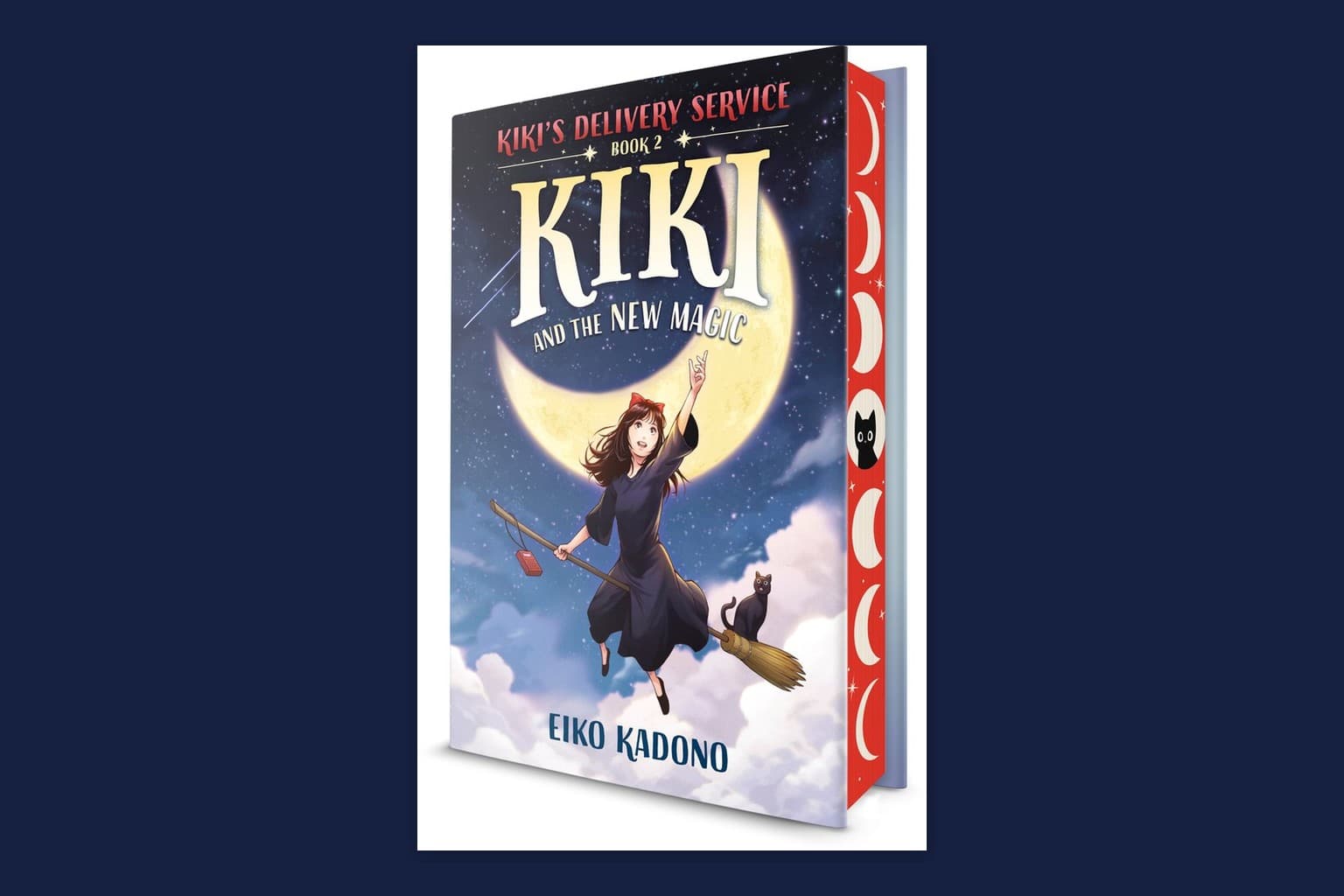
Plenty of American households know Kiki only as a Ghibli girl on a broom.
Hayao Miyazaki’s 1989 film made her famous. Eiko Kadono’s novel came first, published in Japan in 1985, and Kadono kept writing about Kiki for another twenty-four years.
On August 25, Delacorte Press publishes the first English edition of the second book, Kiki and the New Magic, translated by Emily Balistrieri with illustrations by Yuta Onoda. It runs 288 pages, and the publisher shelves it for ages 8 to 12.
Kadono is 91 now. In 2018 she won the Hans Christian Andersen Award, the closest thing children’s literature has to a Nobel. Kirkus calls the new book “bright and quirky,” with “an affectionate portrayal of adolescent change.”
If your household has watched the movie forty times, the news worth passing along is that Kiki’s story kept going on the page, in a much quieter register.
The film is where most American kids meet Kiki, and it ends. Kadono wrote six books about her. An English volume two gives middle-grade readers a version of growing up that is built out of ordinary weeks instead of one dramatic rescue.
What Miyazaki changed, and what Kadono kept
The film gives Kiki a crisis. She loses her magic, and the story builds toward an airship rescue. Neither happens in the first novel, where her broom simply breaks and she has to get it fixed.
Kadono’s book is episodic: deliveries, neighbors, small problems solved with a good heart. She was unhappy enough with the screenplay that production nearly stalled. Miyazaki and Ghibli producer Toshio Suzuki went to her house, then brought her to the studio, and she signed off. She reconciled with the film later.
Readers who only know the movie often arrive expecting the same emotional weather. The novels sit closer to Anne of Green Gables with a broomstick: chapters shaped like a year, real humor, growth that does not need a catastrophe to prove itself.
Jiji also keeps talking on the page. In the film, his silence is how you know Kiki has grown up. Both versions care about independence; they keep score differently.
What the sequel is actually about
Kiki is fourteen in the sequel, a year into living on her own, and the courier who was new in town has become a local celebrity. The publisher’s line is that fame comes with its own set of challenges: her friendships with Jiji and Tombo get tested, doubts creep in, and she starts wondering what her work is actually for.
Kirkus describes a year of errands rather than a single crisis. Elderly customers hoping to revisit an old memory. A damaged broom. A floral dress that makes Kiki wonder why witches always wear black.
Osono, the baker who rented her the room upstairs, now has a toddler. Kiki experiments with witch medicine. The stakes are ordinary, and the book is not apologetic about it.
That register tends to land hardest on readers old enough to feel competent and still new enough to feel unsure. Independence here looks like deliveries, broken equipment, and the work of staying yourself once people start watching.
There is also a nice piece of family history buried in the book. Kadono has said she started the series after her young daughter drew a witch with musical notes flying around her, and Kirkus notes that the sequel is “punctuated with lyrics of curious songs.” Four decades on, the songs are still in there.
Who this is for at the dinner table
If your kid loved the film at seven, this is a natural next shelf at eight or nine. Kirkus flags the episodic structure as good for read-alouds, which helps if you have one strong reader and one listener in the same room. There is an audiobook too, read by Kim Mai Guest.
If you are the adult who cried at the movie and never knew there were sequels, start with Balistrieri’s 2020 translation of book one, then move to New Magic. Delacorte is putting out a deluxe edition of the first novel this summer as well.
For households already juggling heritage media and English bookshelves, this one is easy: a Japanese classic in a careful English edition, illustrated for readers now, with nobody pretending the film and the novels tell the same story.
Library hold lists are the practical move this week. The book is out August 25.
What comes after book two
Kadono finished the Japanese series in 2009: six volumes over twenty-four years, following Kiki well past fourteen. English readers are a long way behind that.
Delacorte’s US listing currently frames three books. The UK Penguin schedule has already named Kiki and the Other Witch for March 2027, again translated by Balistrieri.
One translated sequel does not mean the rest of the Japanese shelf lands next spring. Expect a slow drip.
Buy the book for the child who is ready for it. Keep the film for the nights when everyone wants Joe Hisaishi’s score and the moon. There is room in one house for both.