
Fifth-Grade Magnet Season Continues While the Court Weighs the Rules
Asian American parents challenged admissions at four selective Montgomery County middle-school magnets, and the Supreme Court agreed to hear the case. This year’s fifth graders are still on the district’s central review calendar.
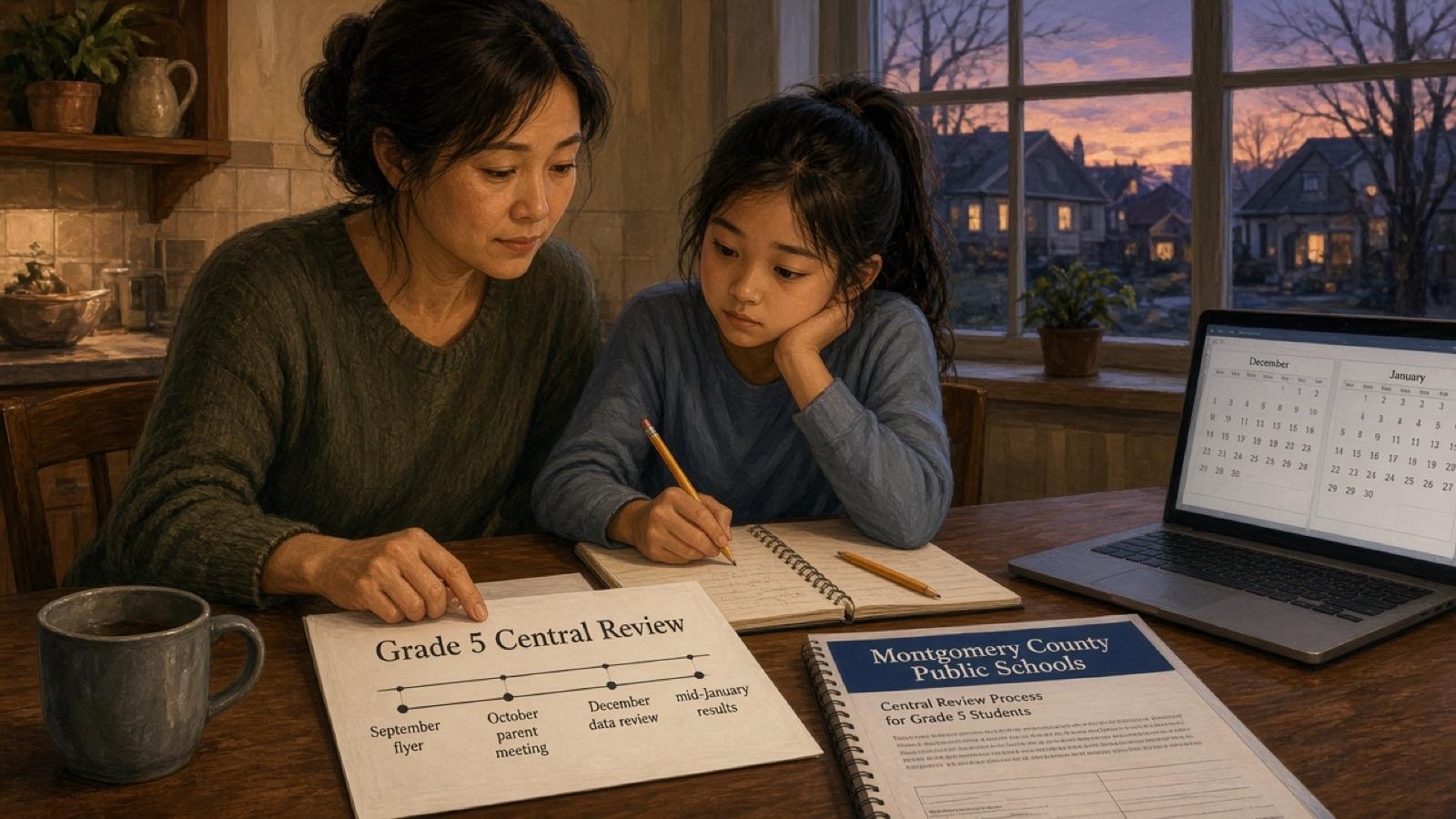
If you have a fifth grader in Montgomery County, Maryland, the September flyer already came home. The October parent presentation is done. December data review is next.
On Oct. 19, the same day those parent sessions ran, the Supreme Court agreed to hear Association for Education Fairness v. Montgomery County Board of Education.
The petitioners are mostly Asian American parents. They say the county’s facially race-neutral magnet process was designed to cut Asian American enrollment at four selective middle-school programs.
The justices will not hand out this year’s seats. They are weighing a threshold question: how those parents have to prove harm.
Until mid-January results arrive, your child’s path still runs through the district’s public materials.
This year’s calendar still runs. The Court will decide how challengers prove harm. The district materials are what you can check before January.
What the Court agreed to decide
The justices took a narrow question. When parents say a race-neutral admissions rule is intentional discrimination, must they show that the targeted racial group, as a whole, did worse than its share of the applicant pool?
The Fourth Circuit said yes, and dismissed the case. Other circuits have let similar claims move forward on more individualized evidence. That split is why the Court stepped in.
AFEF argues the lottery and local MAP norms were built to shrink Asian American shares at the selective magnets. The school board calls the policy a race-neutral pandemic lottery and points to Asian American selection shares that still outpaced the group’s share of applicants in the record the lower courts used.
SCOTUSblog expects argument early next year. A decision would likely land by the end of the 2026–27 term. None of that rewrites the mid-January letter your fifth grader may get first.
The four programs in the lawsuit
The case focuses on MCPS’s criteria-based middle magnets. It does not cover every Choice or immersion program in the county.
Humanities and Communication runs at Eastern Middle School and Martin Luther King, Jr. Middle School. Mathematics, Science, Computer Science runs at Roberto Clemente Middle School and Takoma Park Middle School.
Where your child can be considered depends on high school cluster. Upcounty and downcounty maps send families to different centers for the same theme. Save the commute debate until a seat exists.
The Middle School Magnet Consortium at Argyle, Loiederman, and Parkland uses a separate Choice process. Keep that paperwork in another folder.
What one fifth grader’s year looks like
Here is the district timeline for 2026–27.
September: a flyer explaining Grade 5 Central Review goes to families, in English and Spanish. October 19: criteria-based magnet parent presentations for upcounty and downcounty, again in both languages.
December into January: MCPS reviews school-system performance data. Current MCPS fifth graders do not submit an application.
Private school, homeschooled, and new-to-MCPS fifth graders have a document deadline of Dec. 2, 2026.
Students who meet the enrichment criteria are recommended for enriched or accelerated courses at their local middle school. They also enter the candidate pool for the matching regional magnet theme or themes.
A lottery fills the regional seats.
Mid-January 2027: parents get Central Review and lottery results. Late January: the Level I appeal window closes. AskMCPS and the Educational Records Services Center are the contacts listed on the special-programs pages.
What the district materials show you, and what they don’t
The public pages give you the calendar, the school list, the region maps, and a clear note that current MCPS students are screened centrally without an application.
The review looks at performance data the system already holds. Options materials name grades, test scores, reading level, and student services such as IEP, ELD, 504, or FARMS among the inputs.
What you will not get is a live lottery feed, or a side door through a parent essay, teacher recommendation packet, or portfolio. Those pieces are not part of this process.
Court filings describe the Pandemic Plan pool in sharper numbers, including A’s in relevant subjects, above-grade reading, and a locally normed 85th percentile on MAP Reading or MAP-Math. Treat those details as the contested lawsuit record. Before you argue percentiles with a cousin, check this year’s FAQ and family letter on the MCPS special-programs site.
One question before the January letter
Write this on the fridge under the flyer: "If our child is in the pool, what do we do the week the letter arrives?"
If the answer is a seat, talk through commute, aftercare, and siblings. If the answer is local enrichment only, decide which home-school courses you will ask about first. If the portal stays quiet, agree who checks email and who leaves the phone downstairs at midnight.
The Supreme Court case may change how future challenges get into court. It will not rewrite this January’s letter.
For this fifth grader, keep the job small.
If you are new to MCPS, mark the Dec. 2 document deadline. Mark the mid-January notice window. Check which of the four schools your cluster feeds.
Then decide, together, what you will say at the kitchen table when the lottery is still the lottery.