
Who Could Afford the First Artificial Womb
No human has been in one. The device U.S. regulators discussed in 2023 is a fluid bag for babies born extremely early, and a 2026 review of the animal studies still found no human trial. Asian and Pacific Islander women already have the highest rate of IVF procedures. Pew's highest-earning newlywed pair was an Asian husband and a White wife.
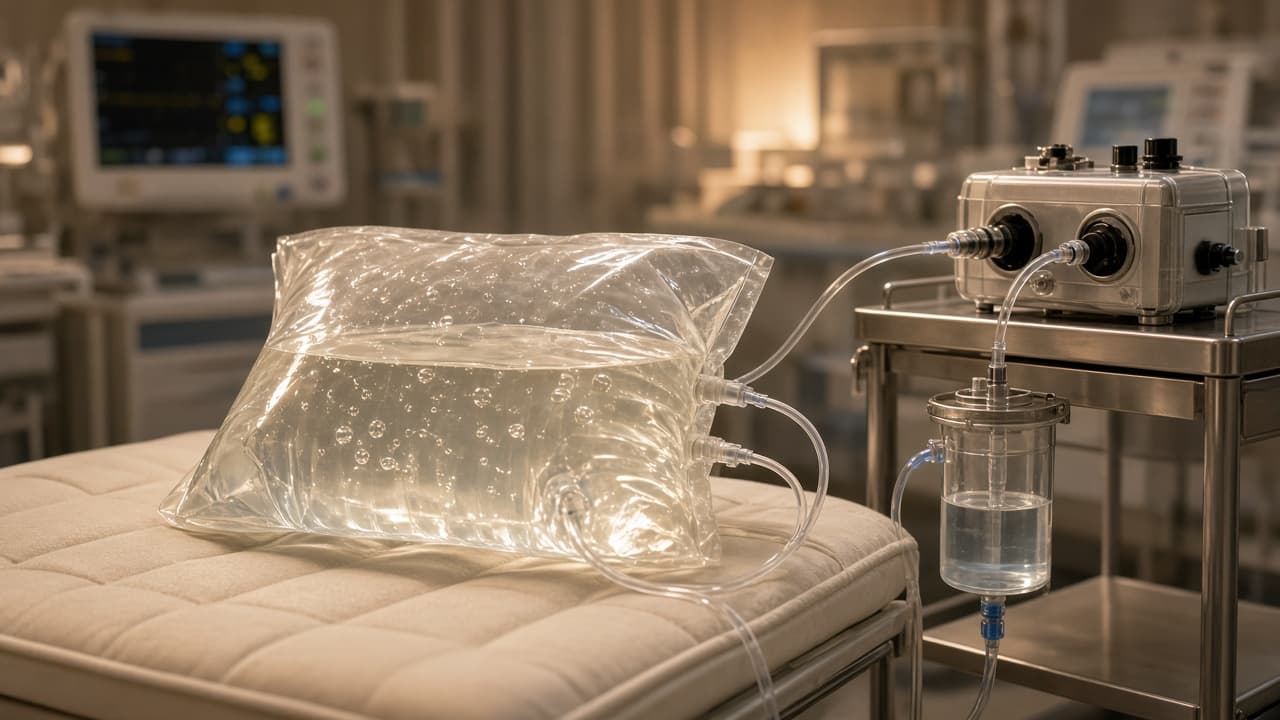
At twenty-three weeks, seventeen weeks of pregnancy are still left. The talk in that room is about a ventilator, and about whether there is anywhere else to put a baby that small.
In 2017, Emily Partridge, Alan Flake, and their team at Children's Hospital of Philadelphia kept eight premature lambs in a closed, fluid-filled bag for up to four weeks. The lamb's own heart pushed blood through a small oxygenator. The lungs stayed full of fluid, the way they are before birth.
On September 19, 2023, the FDA's pediatric advisers sat with that idea for human infants born extremely early. They walked through what a first study would have to show. No study was approved.
A review published in January 2026 read 22 animal studies. No person has been in the device. The four-week bag is one laboratory's longest run, and most of the systems that use a pump lasted up to about a week.
The failures in those papers are the ordinary ones of intensive care: a line that will not stay in, a clot, bleeding, infection. None of the studies came from a low- or middle-income country.
In October 2025, Phillip Wozniak and Stephanie Kukora, a neonatologist at Children's Mercy Hospital in Kansas City, wrote that the first human studies are likely within a few years. A family still needs a consent form with a hospital's name on it.
Hospitals already use software to watch a baby's oxygen. If AI changes this timeline, it will be by noticing trouble sooner. The step that changes a family's week is still permission to try the bag on one infant.
If a trial opens, the decision is whether to move a baby born at the edge of survival into an experimental bag. The households that can already reach a children's hospital, and already pay for fertility treatment, are the closest picture of who would hear that offer first.
The bill that already exists
There is no price for an artificial womb, because there is no product to buy. The charge families already know is the stay itself.
In March 2026, a study of 48 U.S. children's hospitals put the median cost of a hospitalization for an extremely preterm infant at about $275,000, using records from 2017 through 2022. Those infants were 7 percent of NICU admissions and about 29 percent of the NICU's cost. The middle half of those bills ran from about $75,000 to about $462,000.
A trial, if one opens, would sit in a few hospitals like these. The parents in the room would be whoever can reach that hospital, and whoever's insurance will consider an experimental stay.
Who is already at that door
Ada Dieke, then at the CDC, counted assisted-reproduction procedures in 2014. Asian and Pacific Islander women had about 5,883 procedures per million women of reproductive age. White women had about 2,888.
Black women had about 1,434, and Hispanic women about 997. Those are procedures, so one woman can be counted more than once. Even so, the rate for Asian and Pacific Islander women was about double the rate for White women.
A national survey of women ages 20 to 49, in 2022 and 2023, asked whether they had ever used help. About 16 percent of Asian women had used any fertility service, close to 15.2 percent of White women.
Medical help to get pregnant was 13.6 percent for Asian women and 7.1 percent for Black women. The procedure counts are where Asian and Pacific Islander women pull ahead. Ever having used any fertility service is a much closer call between Asian women and White women.
Income lines up with use in that same survey. Any fertility service was 9.5 percent below 150 percent of the poverty line, and 17.2 percent at 450 percent of poverty or above.
Dieke's commentary, drawing on earlier studies, also noted that Asian and Pacific Islander women reported a longer stretch of infertility and started treatment older. High use and a late start show up in the same records. No survey has asked parents about a bag that is not a product yet.
Pew's Census look at newlyweds from 2008 to 2010 still has the pairing people cite. An Asian husband and a White wife had the highest combined median earnings, about $71,800. They were a small slice of new marriages.
Census has not redrawn that chart. Asian households as a group still lead the major race categories, with a median of $121,700 in 2024.
In that top row, the person who would go into labor too early is the White wife. The bank account is shared, and the pregnancy is hers. The call to her parents and the call to his may be two different conversations.
If that is your marriage, or any marriage that can say yes to a children's hospital, the question is specific. At 23 weeks, who calls the grandparents, and can you carry a stay that already runs a median of about $275,000 before a new machine is in the room.