
Raising a Bilingual Child When You Aren’t Fluent
Parental fluency is not the only input that counts. A child needs enough of the language, from people who can actually speak it, in places that do not feel like a test.
Second-generation parents often feel they failed before they start. This guide sets a goal you can keep, maps who else can carry the language, and tells you what not to do at the dinner table.
Leah Chen writes about mixed families, bilingual homes, and helping kids feel whole across more than one story.
You do not have to be the fluent parent
Most people reading this know the shape of it already. English took over somewhere around first grade, relatives made a comment about it every few years, and now there is a toddler in the house, a rusty hello, and a low hum of dread about being the generation that let the thread go.
ASHA's public guidance is blunter than the guilt: talk with your child in the language you are most comfortable using. That is where the full sentences, the stories, and the back-and-forth come from, and that back-and-forth is what actually builds language.
If your comfortable language is English, using it for real conversation is not a betrayal. Performing a fluency you cannot hold past Wednesday is the move that leaves a child thin in both languages.
The heritage language still needs fluent voices, and they do not all have to be yours. Grandparents, a caregiver, a community class, a tutor, a playlist, a stack of books. Your job is closer to producer than native speaker: decide what the household is aiming for, then find the people and hours that can carry it.
Pick a bilingual goal you can live with
Fluency is a pile of separate skills that relatives tend to collapse into one report card. Pulling them apart is what makes the next few years survivable.
Receptive bilingualism means your child understands more than they say. That is already a gift at a grandparent's table.
Conversational bilingualism means they can greet, request, joke a little, and get through a video call without you hovering on every word.
Literacy means reading and writing, and for character-based or highly inflected languages it almost always needs real instruction rather than kitchen talk alone.
So write your goal down in one sentence before you shop for anything. "I want them to understand Grandma and answer in short phrases" leads somewhere very different than "I want them to read a novel," and only one of those requires tuition. Our weekend heritage school guide handles the literacy track; this page is for the household starting from a parent who is not fluent.
Exposure is not the same as a lesson
Exposure is the language in the air: a song during dishes, a cartoon, a grandparent on speaker, you repeating the same three phrases at dinner every night.
Formal instruction is someone actually teaching characters, grammar, or a curriculum, whether that is weekend school, a tutor, or an app that assigns homework.
If literacy is the goal, a child needs both. If the goal is warmth and comprehension, exposure does most of the work.
This matters for a rusty parent because you are genuinely good at one of these and genuinely bad at the other. You can keep the same greeting and the same bedtime line for years. You cannot be the sole teacher of a writing system you never learned.
So lean where you are strong. The trick is not intensity, it is putting the language in the same few pockets of the day until nobody has to decide.
What to do at each age
Infancy is mostly soundtrack and faces, so narrate the diaper change in whichever language comes out of you easily, and let heritage songs, a board book you can point through, and a weekly video call with someone fluent do the rest. Babies are not grading your accent. They are collecting repetition from people who love them.
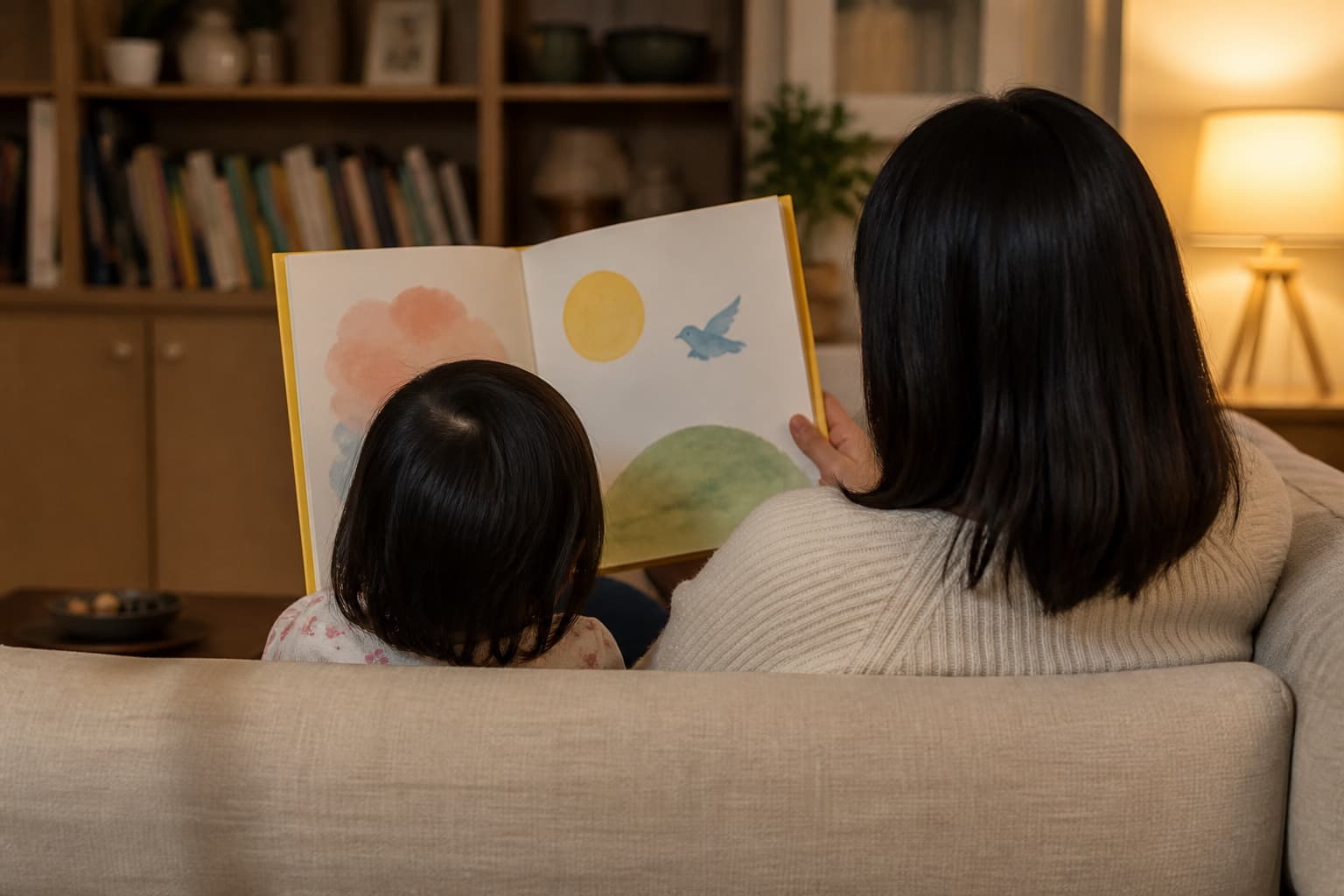
Preschool runs on play. Keep the same mealtime phrases until they are furniture, and read the same picture book until your kid can "read" it back to you in either language. A warm play-based class with a friend in it can help a lot at this age. A class that runs on drills and ends in tears is worth skipping so you can protect the pockets you already have at home.
Elementary school is when English usually wins the public hours, and it is also when literacy, if you want it, needs an actual teacher. Keep your speaking time at home even when the answers come back in English. What does not work is stacking Saturday school on top of two tutors and calling the exhaustion culture.
Teenagers will negotiate, so negotiate. Hand them the format choice: a credit-bearing class, a tutor they picked, a cousin group chat, a drama they would watch anyway. Plenty of adults come back to a heritage language once the playground pressure lifts, and your job in these years is mostly to keep that door from slamming.
| Age | What you can run (even rusty) | Where to borrow fluency |
|---|---|---|
| Infancy | Songs, same daily phrases, bilingual board books, your strongest language for rich talk | Grandparent video, fluent caregiver, heritage playlist |
| Preschool | Play, picture books, mealtime scripts, one protected pocket a day | Playgroup, warm class, auntie who likes teaching |
| Elementary | Keep home phrases; don't quiz; protect rest | Literacy class or tutor if reading is the goal; cousins; shows |
| Teen years | Negotiate the format; stay warm; drop the loyalty test | Credit-bearing class, media they chose, travel, peer group |
Age bands follow ASHA's public multilingual tips (start early, practice over perfection, varied speakers and settings) plus the practical split between home exposure and formal literacy instruction.
Who else can carry the language
Grandparents are usually the richest fluent input a household has access to, on the condition that they can be warm about it. A standing Sunday call does more than a once-a-year remark about how the child "doesn't know anything." Give the child a heads-up before you dial: "Gong Gong is going to ask what you ate. You can answer with the food words we practiced."
A caregiver who speaks the language is a gift with logistics attached. Ask what actually gets said during the day, because songs, snack negotiations, and running commentary all count while silence in front of a tablet does not.
Community school can supply peers and literacy, but it cannot supply a household that uses the language. Pair it with something at home, or skip it and put the hours elsewhere. Our guide for when a child does not want heritage school covers the version where Saturday has already become a fight.
Media is scaffolding rather than practice. A show in the heritage language after homework keeps the sounds familiar, and it still will not ask your child a question.
Thirty minutes with a tutor can beat a dreaded three-hour Saturday, if the difference is that your child is still showing up in June.
High-frequency phrases worth learning yourself
You do not need a thousand words. You need a small set you will still say on a Tuesday when everyone is tired and the rice is late.
Our heritage phrase library has the wording in several languages. The useful work here is deciding what your handful of phrases needs to cover.
Greetings and closings: hello, I'm home, good night, I love you.
Body and feelings: I'm hungry, I'm tired, that hurts, I need a hug.
Requests: more please, help me, wait, all done.
Praise: you did it, thank you, I'm proud of you.
If your child answers in English, recast once, warmly. "You want more water. 물 더 주세요." Then get the water. Do not hold the cup hostage for a perfect sentence.
When they answer in English
Code-switching (mixing two languages in one stretch of talk) is how bilingual people actually speak. ASHA says blending words or grammar is an expected part of learning more than one language. It is not proof that the child is confused.
Relatives may hear an English answer as disrespect, which puts you in the middle. You can protect your child from that reading and still hand them the heritage sentence.
The move is to answer the meaning first, then model the phrase you wish had come out. "You want the blue cup. 蓝色的杯子." Then keep going, because the goal is a conversation rather than a correction.
If you freeze and correct every mixed sentence, they will stop offering you any sentence.
Comprehension often runs ahead of speaking. A child who understands a joke in Korean and answers in English is still building the language. Count that.
What not to do
Do not use shame as curriculum. A line like "you don't love Ah Ma if you won't go to Chinese school" teaches a child that the language is a debt they owe, and debts are the kind of thing people learn to avoid.
Do not correct constantly. One warm recast is teaching; a running commentary on every sentence turns dinner into a performance review.
Do not compare siblings, or cousins abroad. The kid who speaks more is not more Asian, and the kid who resists is not the family's failure.
Do not convert the whole house into a language you cannot sustain past Wednesday. The collapse comes with guilt, and the guilt usually lands on whoever is smallest.
Do not drop the heritage language because a well-meaning person said two languages would delay speech. Speech-Language & Audiology Canada has warned that counseling families out of bilingualism has costs for identity, family talk, and school. ASHA is clear: using more than one language does not cause a delay.
A weekly exposure planner
Aim for contact most days rather than one heroic Saturday. A plan you can run while making dinner will outlast the ambitious one you abandon in October.
The table below is a shape, not a prescription. Most households find that two pockets they never skip do more than five they attempt in a good week and drop in a bad one.
If you miss a day, start the next one. Languages wait, and no relationship should break over a streak counter.
| Time | What happens | Who can run it if you aren't fluent | |
|---|---|---|---|
| Morning greeting | 2 minutes | Same hello, I'm home, I love you | You, once the lines are automatic |
| Meal or bath | 5–10 minutes | Hungry / more / all done, plus a song | You, or a recording of an elder |
| Story or show | 10–15 minutes | Picture book or one episode in the heritage language | Bilingual book you can point through; show with you nearby |
| Live fluent speaker | 20–40 minutes, 1–3x a week | Grandparent call, playdate, tutor, or class | Someone who can give full sentences |
| Weekend culture | 30 minutes | Cooking, market, temple, or a family show | Anyone in the house; language is a side effect |
Planner shape follows ASHA's emphasis on daily practice, varied speakers and settings, and books, music, and programs as supports. Times are household targets, not clinical doses.
When to get speech-language guidance
Bilingualism does not cause a delay. A delay can still happen in a bilingual child, the same way it happens in a child who only hears one language, and the two facts get confused constantly.
ASHA's parent page uses the early milestones you already half-remember, counted across both languages: first words around age one, two-word phrases around age two. "More juice" can be one word from each language and still count.
The clearest reason to call someone is a child who looks like they are struggling in every language they use, not only in English at preschool. ASHA's clinical guidance on late language emergence also flags a common threshold: fewer than 50 words and no two-word combinations by 24 months, again counting both languages together.
Speech that familiar adults still cannot understand much of after age four is worth a call, and so is losing words the child used to have.
Look for a speech-language pathologist who asks about both languages before testing either. Assessing only English can make an ordinary bilingual child look delayed, and ASHA ProFind is a reasonable place to start searching. In Canada, Speech-Language & Audiology Canada sends the same message to schools and clinicians: dropping the home language is not the fix.
If a professional tells you to stop the heritage language, ask for a second opinion. You are allowed to keep the language that lets a grandmother say good night.